How to Answer Estimation Questions
Estimation interviews typically last from 40 minutes to an hour.
Some interviewers will ask two or three questions with little follow-up. Others may ask a single estimation question and spend 15 minutes diving deeper into the details.
Remember that, similar to other PM interviews, interviewers don’t expect you to arrive at a correct answer. They’re interested in how you solve problems given limited information; a situation you’ll find yourself in frequently as a PM.
The key to solving ambiguous problems is to break them down into manageable pieces that you can address individually. Once you’ve gotten a handle on the component pieces, you can build those components back up in a way that’ll result in a reasonable estimation.
Practice is critical when it comes to estimation questions. You’ll build confidence in your ability to break down problems and estimate unknowns with time. If you’re new to the process, a helpful tip is to learn benchmark facts that could reasonably come up in estimation interviews.
Facts like the current population of the world, average global life expectancy, the cost of the latest Google Pixel, or your target company’s annual revenue prove helpful more often than you might think. Having a few figures like these in your back pocket can help jump-start your process and ground your answer in reality.
A framework for answering estimation questions
After reviewing benchmark facts, we recommend familiarizing yourself with the following 5-step framework for estimation questions.
Step 1: Scope the problem
Step 2: Break the problem down
Step 3: Estimate unknowns
Step 4: Answer
Step 5: Explain why you’re wrong
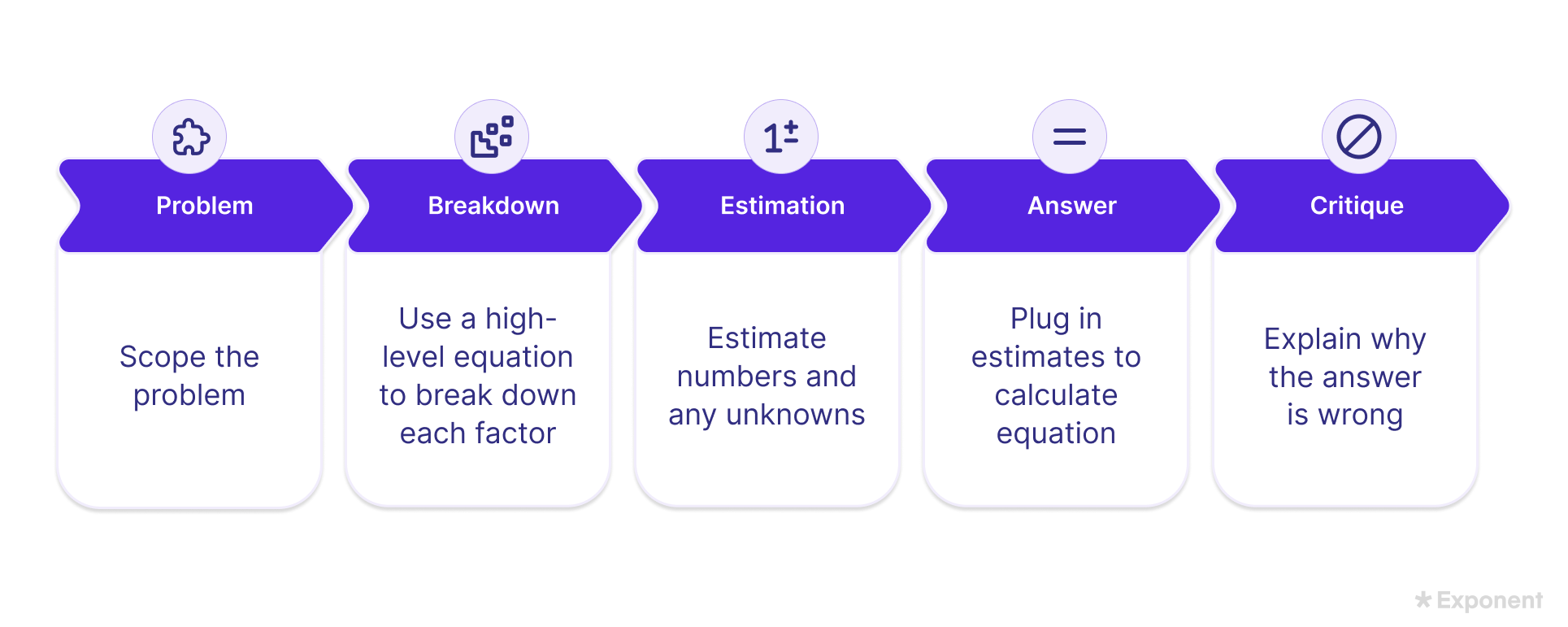
Let’s work through an example to illustrate. Assume you’ve been asked:
“Estimate the number of stacked quarters needed to reach the height of the Empire State Building”
Step 1: Scope the problem
Ask questions to clarify the scope of the problem. This will prevent you from taking the question in the wrong direction and give you a chance to glean helpful information from your interviewer.
For example, if you were asked to estimate the weight of a school bus, you’d want to ask:
- Does the weight estimate include a full tank of gas?
- Does the weight estimate include humans inside the school bus?
- How many people is the school bus expected to seat in total?
Instead of giving you a straight answer, your interviewer may tell you to make assumptions about the scenario as needed. If this happens, state any assumptions that feel reasonable to you and make the problem easier.
For instance, if your interviewer declines to answer your questions about the school bus's weight, assume the gas tank is empty.
Step 2: Break down the problem
Once you’ve scoped the problem, you can break it down into manageable pieces.
First, find a reasonable high-level equation that describes the problem.
Then, based on that equation, break down each factor further until you’re left with something you can reasonably estimate.
As you break down the problem, you’ll likely have to make more simplifying assumptions. That is expected; simply communicate your thought process to your interviewer.
If you believe an edge case (e.g. whether or not there are vaulted ceilings) is critical to your estimation, be sure to state your assumptions up-front. If you decide that it’s not worth identifying that component, communicate this to your interviewer as well.
Step 3: Estimate unknowns
Once you’ve broken the problem down into estimable pieces and explained your approach, it’s time to estimate numbers.
Break down each component until you arrive at something you feel confident estimating.
Remember, the numbers don’t matter. There are always other ways to slice the problem or to break down a factor into something you can work with.
Here are some tips to get you going if you’re drawing a blank.
- Recall any benchmark facts you memorized. Is there anything helpful?
- Estimate using a proxy value. Can you make reasonable assumptions using a known fact as a jumping-off point?
- Segment diverse groups. Don’t try to make assumptions about the behavior or diverse groups. Instead, segment in a way that’s meaningful to your question, and sum the individual estimates.
- Use a personal reference. Can you relate the unknown quantity to something you do know, even if it’s anecdotal? Don’t forget to communicate that you’re offering anecdotal and possibly biased information to your interviewer.
As you estimate, don’t forget to gut-check your numbers. If they feel reasonable, go ahead. If something feels off, revisit your math or break the problem down further.
Step 4: Answer
Next, plug in your estimates for key variables into your high-level equation, and compute the total. Be sure to:
- Convert any mismatched units before the final calculation
- Round difficult numbers for simplicity
- Communicate each step of your computation
If you’ve been gut-checking along the way, you should feel reasonably confident in your answer, but we recommend gut-checking your final number as well.
If something feels very wrong, it’s worth checking the assumptions you’ve made along the way and double-checking your math.
Step 5: Explain why you’re wrong
This last step is crucial.
Your answer is wrong.
Based on your final gut check, you should have a sense of whether you’ve under or over-estimated.
Take 1-2 minutes to share your critiques with your interviewer. Summarize any estimations that felt like guesses. Describe what you’d reconsider if you had more time, taking care to list any elements you ignored for simplicity that, upon review, may have large implications for your answer. If you’re unsure of where you may have made mistakes, it can be helpful to ask yourself what facts you’d have liked to have had on hand when you were first given the question. How did you make do without that information? What substitutions and assumptions were necessary? If you used any of the recommended strategies above (estimation by proxy, personal reference, etc). be sure to list the potential errors in those approaches.
Being proactive here demonstrates important PM skills like critical thinking, and communication. A thorough recap also preempts follow-up questions from your interviewer.