Tips for Acing Questions on Cross-Functional Relationships
Because your success as a TPM hinges on your cross-functional relationships, remember that interviewers are looking for:
- Experience working with and navigating different stakeholders
- Experience and "style" collaborating
- Dealing with conflicts, disagreements, and difficulties
Here are some tips to keep in mind when prepping for cross-functional questions:
- How would you convince other teams to support your idea?
- How do you manage disagreements with product managers or engineers?
- Tell me about a time when you had to manage multiple stakeholders with competing interests.
Study company values
Companies are always assessing for culture fit. Every time you answer a behavioral question, try to showcase yourself as a match to the existing company culture. We promise - this is easier to do than you think. Here are the company mission and values pages for a few top tech companies.
Be sure to look for similar information on your target companies.
Seed your story bank with one big, complex project.
Begin with the prompt:
Tell me about the biggest cross-functional team project you’ve led or participated in, including when it happened, the purpose of the team, and the results achieved.
By concentrating first on the most complex project you've worked on, you'll cover all your bases when you begin building out a bigger story bank to cover all behavioral questions (later on in this course.)
Diagram your story to include relevant stakeholders.
Visual aids help you properly capture all important stakeholders and how your actions affected them. Try this schema next time you're working on project-based interview prep:
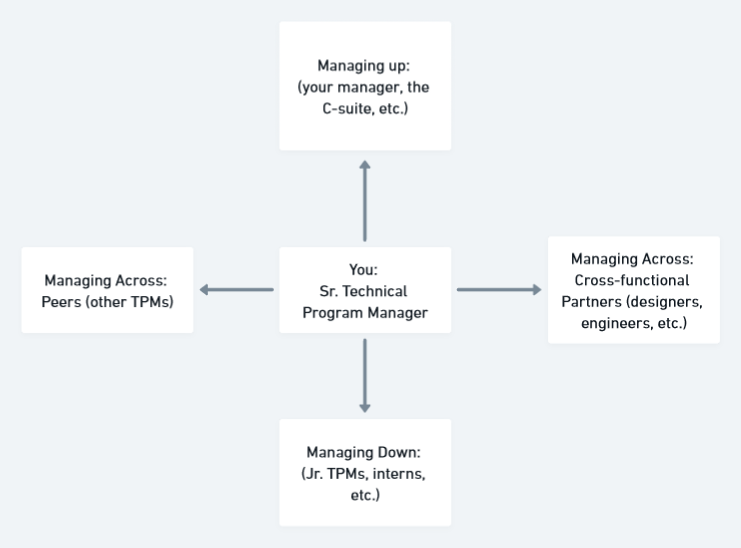
Think through the priorities of each group, what they wanted, and how you navigated and balanced these needs. Spend extra time on any disagreements. You'll surely be asked follow-ups about how you handled conflict.
Fill in the details interviewers are looking for.
Interviewers want to get a sense of a few key things. Make sure you include:
- The underlying pace of the organization. Were you under pressure to undergo rapid change? Or were you working at more of a steady-state?
- The size, importance, and makeup of the teams involved. For example, did you work with a team of three? five? twenty-five? Were they junior or senior? And how many functions were involved?
- Who you influenced with a specific focus on the level of the person (i.e., peers, subordinates, superiors, executives, outside consultants, and vendors).
- the growth of your role and influence. Do you eventually grow more involved at the strategy and planning level, and in cross-functional leadership positions?
- The overall success of the team projects and your specific role in achieving this.
Here are a few additional tips to keep in mind when interviewing.
Use numbers wherever you can.
Don't get so caught up in relationship mapping that you forget to quantify your results. Interviewers want to know who you worked with, but at the end of the day, results are your strongest asset.
Don't lose focus on your own contributions.
As a Senior Client Lead Recruiter, Global Specialty Fulfillment @ Amazon puts it:
"Interviewing is not the time to minimize what you have done."
If you’ve taken the time to dive deep and recorded specific details, this shouldn’t be hard. Let the results speak for themselves. You’re here to sell yourself.
Demonstrate a readiness to learn.
Things won't always go smoothly when working cross-functionally. You'll have disagreements and projects will fail. Interviewers love questions about the "hard stuff" because they want to know how you'll respond to adversity. There's nothing wrong with an occasional failure - as long as you learn from it.
When answering questions around conflict or failure, ending with what you learned is a slam-dunk.