How User Research Fits into the PM Process
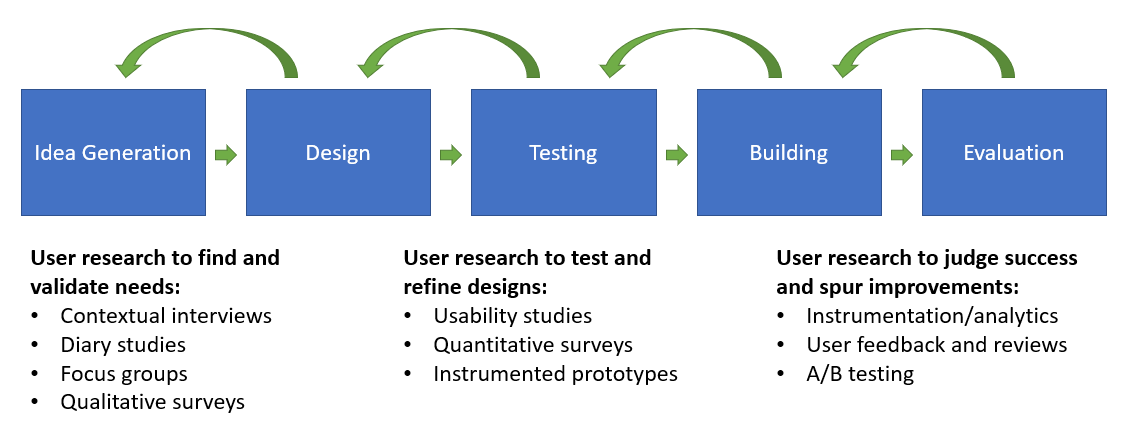
User research can help you make better decisions throughout your product development process. When you're creating a new product or feature, you go through five broad steps: idea generation, design, testing, building, and refining.
- Idea generation: whom do you want to serve? what problems do you want to solve? is there a (big enough) untapped market for solving those problems?
- Design: what might a solution look like?
- Testing: does the solution you've designed work? can people figure out how to use it? does it solve their problems? would they be willing to pay for it?
- Building: convert the solution into a scale-able product!
- Evaluation: what aspects of our product do people use? how well do they work? what would make it even more useful?
These steps are iterative. For instance, testing may lead to more designing, or even to new idea generation, before building.
User research can help you throughout this journey, particularly in the idea generation, testing, and evaluation stages. Here, we'll broadly discuss how user research fits in; for more details on the specific methods mentioned, see "choosing a user research method" later in this module.
Idea generation
Idea generation happens at the beginning of the product development process, in two stages. First, ideas must come from somewhere (your head, engineers' suggestions, user requests). Then, ideas must be judged and prioritized to determine whether they're worth moving along to the design stage of the process. User research plays a role in both parts.
Say you are designing a product from scratch. Spending time with your potential users will give you a wellspring of pain points you might want to address. Perhaps you're designing for grandparents. Through interviews and diaries, you discover that despite all the video chat platforms out there, grandparents don't feel sufficiently connected to their grandchildren. Or maybe you're looking to create a B2B product for small teams. You shadow people at a handful of companies and find that their documentation systems are a mess, and meeting notes never seem to get shared or archived. Through user research, you've identified your future customers' pressing needs.
Next, you need to check: does it make sense for you to fill these needs? Some of that is a matter of evaluating your team's interests and capabilities, but you'll also find it useful to go back to the users. How widespread are these needs, and how time and money are people willing the spend to address them? You might use a combination of interviews, surveys, market data, and competitive analysis to find the answers.
Once you've answered those questions, you get to move to the design stage. Brainstorm solutions to the problem you've identified, pick the most promising concepts and turn them into prototypes (whether sketched on a napkin, pieced together with blue foam, or interactive digital mocks).
Testing
Congratulations, you have prototypes! What now?
User research plays an essential role as you turn prototypes into a product. You want to get those prototypes in front of users early and often, to validate both the concept and the details. Do they even want this product? Does it solve the problem you intended to address? Can your potential customers easily figure out how to use it? Does it delight them? You'll probably go through several rounds of usability testing before you finalize your design. Initial rounds might prompt you to change the entire look or function of the product; later rounds may lead you to rearrange menus, edit text labels, or resize buttons.
Once your design is 80-90% settled, your engineers will start building. You'll want to repeat usability testing after the product is built; a fully functioning product (or a feature in the context of a full product) is never quite the same as even the most detailed prototype. These tests may inspire further changes.
Usability testing is small-sample and not statistically significant. (A round of tests in the lab is usually just four to eight participants.) That's fine: you're looking for qualitative insights, not causal patterns. But sometimes you want to answer questions at scale during the testing/building process. For instance, you might want to know which color scheme(s) users prefer. Other user research methods, like online surveys, can answer those questions.
Evaluation
Once you've launched your product, you must continue testing it. You want to monitor usage and satisfaction (both quantitative data and qualitative feedback) and find ways to improve. Look for links between product changes and user behavior, via A/B tests and post-launch analytics. Those tools are great for testing incremental changes at scale, or for monitoring the performance of something you've already built and launched (in contrast with the more exploratory user research of earlier stages). You might follow up on issues you notice (unused portions of the product or negative feedback) with further usability tests. What you learn might also spark new features or complementary product ideas and send you back to the idea generation and design stages!
A/B testing and analytics are covered in detail in our modules on experimentation and analytics, not here.